Showing posts with label the transit camera. Show all posts

Wednesday, January 27, 2021

Transit Fanning in 2020, a Review.

 2020 brought on some unexpected changes and alternate plans for many, with my own plans for the year being no exception. While social-distancing, limited travel options, and cancelled vacation plans surfaced, I decided to make the best of the free time I had and managed to go out and explore in my local region. Here is a recap of the transit systems and operations I was fortunate enough to visit or document during what was a rather crazy and unpredictable year.

  1. Metro Transit, Twin Cities, MN. This is my home system, was easy enough to visit as I use and see it on an almost daily basis. For a notable photo to represent it this year I chose one of my first ones taken, which is of a  retired 71xx series Gillig Hybrid unit. These were obtained in 2007 by the agency and marked their first major hybrid bus purchase. They were fairly unique as these buses were originally ordered and spec'd for operation by the RGRTA - Regional Transit Service of Rochester, NY. Metro Transit 7113

  2. Metropolitan Transportation Services, Twin Cities, MN. MTS is a division of the Metropolitan Council which oversees contracted route operations among other things. Their bus services are essentially the same as Metro Transit, however the actual operations are contracted to various private operators. For a representative photo in 2020, here is bus 1445 on route 16 in downtown Saint Paul. The bus is being operated by contractor Metropolitan Transportation Network, a school bus contractor based in Fridley, MN. MTN ceased operating the transit routes for MTS a short time later with the buses and operation transferred to First Transit. Metropolitan Transportation Services 1445

  3. Janesville Transit System, Janesville, WI. Now, onto what turned out to be the first road trip of the year. The first stop on this trip was in Janesville. here is JTS 451, a Gillig Low Floor 35' unit seen in a shopping plaza off of Milton Ave. JTS had previously operated an all New Flyer fleet of buses, which were getting quite old and maintenance intensive. The system was finally able to acquire some funding for new buses in 2019 with Gillig being chosen as the manufacturer. Janesville Transit System 451

  4. PACE, Schaumburg, IL and greater Chicagoland. The next system covered on this road trip was PACE Bus. The fixed-route fleet of 35' and 40' buses at PACE has steadily evolved from once being largely Orion VI and NABI LFW units, to Eldorado Axxess units. Here bus 6409 is seen on layover by the Northwest Transportation Center in Schaumburg. PACE 6409

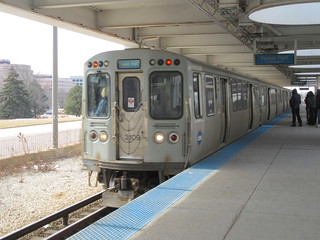
  5. Chicago Transit Authority, Chicago, IL. Venturing on to the destination of this road trip, the Chicago Auto Show, it's impossible to not encounter the CTA! Here is the first CTA vehicle encountered, car 3109 leading a Blue Line train on an inbound run at Rosemont CTA. CTA 3109
  6. Madison Metro Transit, Madison, WI. While returning from Chicago to the Twin Cities, a quick stop in Madison was able to be made. Bus 1913 represents the shift from being a largely Gillig Low Floor fleet, to the agency's latest bus procurement of New Flyer Xcelsiors. 1913 also sports the new Metro Transit brand and livery, a change from the previous Madison Metro 'M' graphics. Madison Metro 1913

  7. Maple Grove Transit, Maple Grove, MN. Back in the Twin Cities again, this lone photo of MGT bus 60126 on layover near Target Field ended up being my only time observing their operation in 2020. This was taken on March 10th, shortly before the Pandemic of 2020 suddenly changed life as we knew it here in Minnesota. Maple Grove Transit 60126

  8. DELTA Airlines employee shuttle system, MSP Airport. April 11th, the Pandemic and statewide stay at home orders now in full effect. DELTA bus 854, operated by First Transit, is seen here at MSP Terminal 1 on the DELTA parking shuttle. The service was suspended a few weeks after this, as using small vans to move any remaining flight crew was more economical. DELTA 854

  9. Minnesota Valley Transit Authority, Burnsville, MN and south suburbs. At the end of April, I drove over to the Cedar Grove Transit Station for a bit of socially-distanced transit photography as state restrictions on travel were relaxed a bit. Motorcoach 4840 was a rather odd sighting being on local route 444. With social-distancing suddenly being a factor and the traditional offering of assorted commuter express routes suddenly suspended with very little demand, these coaches were run on the route in lieu of the usual 40' buses. MVTA 4840

  10. Mayo Clinic Campus Shuttle, Rochester, MN. With travel restrictions relaxed as more was learned about the virus and contending with it's effects, it was time to get out of the day-to-day routine and go on a quick day trip. Rochester, MN was the destination this time. Here Groome Transportation bus 684 is seen on the Mayo Clinic shuttle. Groome took over the shuttle system operations at some point in 2018 after Laidlaw Transit and the First Transit had operated it for several years. An entirely new fleet of buses was brought in, these being the ARBOC Spirit of Equess model. Groome Transportation 684

  11. Rochester Public Transit, Rochester, MN. Obviously one cannot go transit fanning in Rochester, MN without encountering the RPT system! Here is bus 276, one of the system's newest buses at the time, seen on layover in the downtown area. Rochester Public Transit 276

  12. MATBUS, Fargo, ND. On to road trip #2, a nice mid-July drive through North Dakota. First stop, Fargo. Here MATBUS 1222 is seen working route 20 at West Acres Mall. MATBUS 1222

  13. Bis-Man Transit, Bismarck, ND. Road trip #2 stop 2, downtown Bismarck. Bus 1909 is a 2019 Alexander-Dennis Enviro 200 model. ADL has been making some progress marketing their 200 model in the North American market among smaller transit operators and agencies. Bis-Man Transit 1909
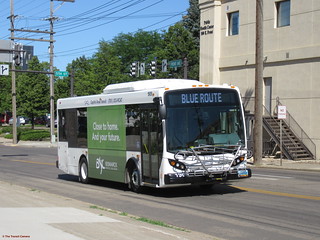
  14. Minot City Transit, Minot, ND. Road trip #2 stop 3, downtown Minot. The Minot city bus system is fairly simple with a series of routes laid out in loop pattern and operated on 60 minute frequency by 3 buses. The fixed-route fleet is comprised of Eldorado EZ-Rider units in both the II Max and BRT styles. Bus 1011 is seen here on the South 1 route departing the Civic Center downtown transfer point. Minot City Transit 1011
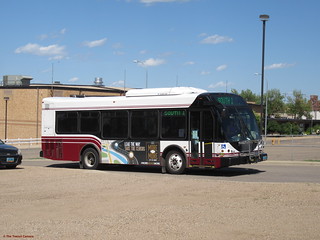
  15. Cities Area Transit, Grand Forks, ND. Road trip #2, stop 4, downtown Grand Forks. CAT operates a fairly robust route network for a city the size of Grand Forks. Routes pulse every 30 minutes at the downtown transit center. One such pulse is seen here, with a representation of the CAT fleet shown. Cities Area Transit Buses

  16. River Falls Public Transit, River Falls, WI. In September it was time for another day trip, so with a destination of Eau Claire, WI I set out, making stops along the way in River Falls and Menomonie. First up, we see one of the River Falls Public Transit vans parked in downtown River Falls near a supermarket. This sort of general public dial-a-ride system is common throughout the US in more rural areas. River Falls Public Transit 307

  17. Dunn County Transit, Menomonie, WI. Bus 318 was the lone unit I managed to get a photo of while in downtown Menomonie. DCT operates 2-3 routes, however the Stout route bus 318 is seen on in this photo is the most frequent. Dunn County Transit 318

  18. Eau Claire Transit, Eau Claire, WI. Bus 504 was one of the newest units observed during this visit. It is a 2020 Gillig Hybrid unit and is seen here arriving at the downtown transfer point on the popular 1-Margaret and Mall route. Eau Claire Transit 504

  19. Southwest Transit, Eden Prairie, MN and southwest suburbs. Having last visited downtown Minneapolis in March, a return trip was made in October to see how things were progressing. This ended up being my lone photo of a Southwest Transit unit in service for the year. Motorcoach 238 is seen here on Marquette Avenue working the 698 route. Southwest and other operators have largely trimmed down their express services during this prolonged period of decreased ridership. Southwest Transit 238

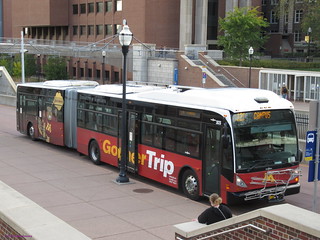
  20. University of MN PTS, Minneapolis, MN. A stop over at the U campus was also made to see the PTS campus shuttles. A few new secondhand Gillig Low Floors had joined the fleet. Otherwise the Van Hool buses were still the backbone. Articulated bus 3826 is seen here on the 121 Connector by Coffman Union. University of MN PTS 3826
  21. MIDAS Transit, Fort Dodge, IA. The final road trip of 2020, with a destination of Omaha, Nebraska was taken during the last stretch of nice weather in mid-December. MIDAS is a service of the Mid-Iowa Development Association Council of Governments (COG) and is based in Fort Dodge, Iowa. The system provides demand-response public transit service in the counties of Calhoun, Hamilton, Humboldt, Pocahontas and Wright. Bus 19-1 was observed during a stop in a shopping plaza in Webster City. MIDAS Transit 19-1

  22. SWITA, Southwest Iowa area. SWITA or the Southwest Iowa Transit Agency is demand-response public transit service serving all residents in the Southwest Iowa counties of Cass, Fremont, Harrison, Mills, Montgomery, Page, Pottawattamie, and Shelby. This bus of unknown unit number was seen while stopping in central Missouri Valley, Iowa. SWITA Bus

  23. Omaha Metro, Omaha, NE. O-Metro has continued to refine and grow it's system since my last visit a few years previous. Of particular interest on this visit was the recently opened ORBT rapid bus line. This service replaced what was route 2 on Dodge St. It provides service on a 10-15 minute frequency with stops made only a designated ORBT stations along the line. Bus 1905 is one of several New Flyer Xcelsior XN60 units dedicated to running the service. They represent the first articulated buses to be added to the O-Metro fleet, and are also the first CNG transit buses, marking the fleet's eventual changeover from diesel to natural gas. Omaha Metro 1905

  24. Sioux City Transit, Sioux City, IA. The final system visited to add to the 2020 list was Sioux City Transit. SCT operates a network of 10 routes on 60 minute frequency with a connecting pulse hourly at the downtown MLK Jr. Multimodal Transportation Center. Bus 1369 is seen as a representative view of the operation, departing the MLK Jr. transit center on route 1. As is or was the case with several transit operators at the end of 2020, a notice is seen taped on the front door alerting riders to board at the rear. The back side is also festooned in a colorful superhero prahic promoting the use of masks in an effort to control the spread of COVID. Sioux City Transit 1369 

Overall with the opprtunity to visit and/or document 24 different transit systems or operations, 2020 was a decent year in that regard. Here's hoping that perhaps during 2021 we will see an eventual return towards some more normality. Meanwhile, be safe, take precautions for your health and to protect others, and stay positive.

Monday, May 28, 2012

Building of Interest

Like most folks, I generally don't go around looking specifically for architecture and building styles when I'm out and about. Nonetheless there are still some things that will catch my eye. For me any building with a decent amount of color or shape will capture my interest.

One building that recently caught my eye was the office building located at 1185 North Concord in South Saint Paul, MN.  It's nothing spectacular, but the way it's built into an area surrounded by a steep hill or bluff, and a not so spacious gap between the road and this bluff, makes it sort of interesting. The colored tiles on each end however really make it stand out.
1185 N. Concord Street
1185 as viewed from across Concord Street looking south
Currently the building appears to be partly empty. I'm guessing at one point however it may have been a thriving office building. Also of particular interest with this building was the custom bus shelter across the street for northbound riders.
Metro Transit Bus Stop
The bus shelter across the street is painted to mimic the color tiles on the ends of the building.
Bus shelters that are specifically built for a business or company tend to be rare in the Twin Cities outside of downtown Minneapolis. This particular shelter structure appears to have been around a while, and was likely added back in MTC days. It is still served by Metro Transit route 71, although I doubt this stop generates as much ridership as it might have previously.

 What the future holds for this building is unknown. However it is an interesting sight. 

Wednesday, May 16, 2012

Minneapolis to Move Towards Single-Sort Recycling System

Despite the move by waste haulers across the metro area to single-sort recycling, Minneapolis has stayed with their original curb-sort recycling method. All that will change however thanks to the Minneapolis City Council's Transportation and Public Works Committee vote Tuesday to transition towards the single-sort system.

City of Minneapolis Recycling Box
An example of the type of recycling container currently used by Minneapolis residents
With the single-sort method, all recyclable materials such as paper, cans, bottles, and boxes are placed together in a single container. The material is collected and then sorted out at the recycling center or collection facility. Containers for recycling are typically larger than the 18 gallon bins Minneapolis currently uses. For example, Waste Management and Allied Waste both offer large carts, with recycling instructions on the lid, for collecting recycling.
Allied Waste Recycling Cart  Waste Management Recycling Cart

Currently, Minneapolis has some of the most extensive sorting requirements available for recycling curbside. There are nine categories, and little tolerance for improperly sorted material. 18 gallon bins with lids are issued for biweekly recycling per residence. The bins tend to fill quickly, which also may contribute to the poor participation rate of 18%.

WCCO TV recently covered the changes coming, and has a report along with this footage of the current system:


While it is ideal to try to produce less waste in the first place, it will be interesting to see if this new system leads to better participation and material recovery for Minneapolis, and Hennepin County.

Tuesday, May 8, 2012

Greyhound Express: A Review

Last week I had the opportunity to travel from Minneapolis to Chicago using the Greyhound Express service. I have previously traveled between the two cities in past years using Greyhound, but had not yet tried the new "luxury" Express version. Overall I was impressed. Here is a brief overview of the experience.

Waiting for the bus:
  • Minneapolis: Express customers wait in the same general waiting area as everyone else who is traveling out of the Hawthorne Bus Depot. While this isn't as select as having a separate waiting area, it certainly works. Additionally Hawthorne was fairly empty while waiting to board on a Sunday evening. 
  • Chicago: Express customers are given a special seating area, at doors 1-6, only available to Express ticket holders. seating in the Express waiting area was not abundant, but still generally available as compared to the other gates.
Boarding the bus:

The Express service does not follow the "every passenger for him/herself", first-come-first-serve, boarding method that regular Greyhound services use. Riders board in groups, 1-10, 11-20, etc. Each ticket comes with a boarding number. Therefore you do not need to line up at the gate until your boarding group is called. This is much nicer than lining up at the gate when getting to the station in hopes of being able to pick a decent seat. This also means you don't necessarily have to show up an entire hour before the bus departs, although it is still recommended.

Once you get to board the bus, e-tickets purchased online will need an ID shown when handing it to the driver, so it is best to have that ready. After turning in your ticket you are free to board, and take any unoccupied seat you like.

Riding the bus:

Greyhound uses new or rebuilt coaches on its Express service, these feature electrical outlets, free wi-fi, and some extra legroom compared to their regular fleet. (After riding I think the first couple rows are still the same for legroom however.)
Greyhound Lines 86335
An example of a coach used for the Greyhound Express service, this is a MCI D4505 unit, and is equipped with power outlets and wi-fi service
Express service is just that, Express. There are usually only one or two stops depending on the distance traveled. From Minneapolis there was one meal stop and then one stop in Milwaukee to drop-off and pickup more passengers. It was the same on the reverse. This was much nicer than some bus trips where it felt almost like riding a city bus because the bus seemed to stop at every corner along the way.

The bus was not very crowded at the times I was traveling. This may vary depending on the day and direction however. Clientele using the service were not exactly the upper-middle class, but they weren't homeless bums and druggies either. Overall it appeared to be decent hard working folks and college students who were riding.

Time:

For this trip, time spent traveling was not excessive considering the mode. It took about 8.5 hours traveling from Minneapolis to Chicago,  and about the same on the return trip. While that is longer than a flight it is also a bit more enjoyable getting to see some of the country along the way. The 8.5 hours also included about 40 minutes of break time while en route.

Price:

This was the best part, $10 round trip between Minneapolis and Chicago. Even a very fuel efficient car can't meet that low price. Airfare? Ha! Now you won't get $10 fare if you want to ride tomorrow, you need to buy at least a month ahead of time for that sort of deal. Still if you want to go somewhere in say, six weeks, and you aren't dead set on driving or flying, Greyhound Express might be a nice option.

Friday, April 27, 2012

A quick look around Winona, MN

Winona, MN is situated on the Minnesota border along the Mississippi River. Population is 27,572 according to the U.S. Census Bureau. Winona has an interesting position geographically, with the Mississippi on one side, Lake Winona on another, and some inlets and wetland filling the ends.

View Larger Map

 Winona has a very nice looking downtown district, with some shops and quiet streets that give it a small town feel. 
Winona National Bank  Winona County Government Center Central United Methodist Church Winona Street


On the outskirts of Winona, there are the usual small city retail outlets including Hy-Vee, ShopKo, Kmart (pictured below), Mills Fleet Farm, and a shopping center. A Walmart Supercenter is located to the southeast.
Kmart (Winona, MN)


Winona is home to Winona State University, and does have a bit of college town vibe with lots of students walking around, a fair amount of rental housing, and a lot of cars. One thing that was interesting however, was how calm traffic was around the campus and the city in general. When people were waiting to cross a street, drivers actually stopped to let them cross, instead of speeding up as they do in some places.


Winona also has a transit system, called Winona Transit Service, which operates four bus routes. While the system isn't very large, and only operates small buses, it covers the majority of the Winona area.
Winona Transit Service Transfer Point Shelter Winona Transit Service 0930

Tuesday, April 24, 2012

Minnesota Transit System Costs Per Ride, a Comparison and Thoughts

Each year, the Minnesota Dept. of Transportation releases a report detailing accomplishments, costs, and ridership for all Minnesota public transit service providers. Looking at the 2011 Transit Report I thought it would be interesting to break down the operating cost and ridership numbers a bit for the major systems. I should note that while the annual operating costs and the ridership numbers are likely a consistent type of data for each system, I am not certain whether the operating costs represent the entire operating cost or just the cost not covered by passenger fares. Nonetheless here are the 2010 numbers, taking operating costs divided by ridership:


Operator Year Operating Exp Ridership Cost per Ride
U of M Transit 2010 $4,894,272 4,044,192 $1.21
St. Cloud MTC 2010 $5,358,104 2,192,736 $2.44
Metro Transit - Light Rail Train 2010 $25,736,121 10,455,860 $2.46
Rochester Public Transit 2010 $4,933,635 1,520,526 $3.24
Duluth Transit System 2010 $10,787,556 3,023,352 $3.57
Metro Transit - Bus 2010 $236,841,961 66,040,533 $3.59
Moorhead MAT 2010 $1,340,216 358,646 $3.74
Mankato Transit System 2010 $1,418,057 354,445 $4.00
Metropolitan Transportation Services - Contracted 2010 $12,513,375 2,915,286 $4.29
Maple Grove Transit 2010 $3,714,999 752,608 $4.94
Ramsey Star Express 2010 $373,781 55,487 $6.74
Minnesota Valley Transit 2010 $16,359,426 2,386,117 $6.86
Southwest Transit 2010 $7,483,460 1,002,382 $7.47
Plymouth Metrolink 2010 $3,649,014 464,142 $7.86
Shakopee Transit 2010 $1,112,474 116,599 $9.54
Prior Lake Laker Lines 2010 $707,647 50,392 $14.04
Metro Transit - Northstar 2010 $15,591,217 710,426 $21.95
Metropolitan Transportation Services - Transit Link 2010 $7,419,325 286,294 $25.92

 It's somewhat interesting how Saint Cloud Metro Bus has one of the lowest costs per ride, as the Saint Cloud metropolitan area is not necessarily a dense urban place. Metro Bus also charges less fare than other systems, with base fare at $1.00 currently instead of the $1.25-$3.00 others charge. Additionally fare may have been lower in 2010. Also noteworthy, light-rail is cheaper than bus to operate on a per ride basis, when there is enough ridership demand. What many anti-light rail supporters fail to mention is that one train set of 2-3 120 person capacity cars can be operated by one operator, versus 3-5 articulated or coach buses for the same capacity, but with 3-5 operators.

University of Minnesota's campus shuttle service however, comes in first. Fare is free on the shuttles, with all operating expenses paid out of student tuition fees. While the shuttles are well suited to capture heavy ridership in a very dense area with lots of demand, I can't help but wonder, what if a regular system stopped charging fares? Would it actually be cheaper in some cases to have free rides and collect fixed fees from property, business, lodging, and rental taxes? Of course many would object to higher taxes, with the usual phrases of socialism scheme, subsidy, spending "hard" earned dollars, so it would be unlikely to succeed. Still there might be enough savings from not maintaining fare collection equipment, dealing with cash, enforcing fares, etc. that it could be worthwhile.

Monday, April 23, 2012

Supercommuters

A recent article in the Rockford Register Star (Rockford, IL) stated 13,700 residents of the Rockford area commute to and from Chicago everyday. Given that the population of Rockford is 152,871 according to the 2010 census data that is a pretty substantial number. This data was obtained by the Star from a February 2012 report by the New York University Wagner School of Public Service, titled The Emergence of the “Super-Commuter”

The "Super-Commuter" is defined by the report as someone who works in a central county in one metropolitan area, but lives outside the boundaries of that metropolitan area. These commuters travel via car, bus, air, or train to reach their workplace as many as five days per week.

Looking at the Twin Cities region, it appears the seven county metro area is also attracting supercommuters. The Northstar commuter rail service, and the Northstar Link service offer a public transit option from the Saint Cloud metro area. A proposed bridge in the Oak Park Heights area would provide more roadway capacity between Twin Cities metro highways and Wisconsin. On the other side, Rochester, MN has some workforce pull from the Twin Cities, with Rochester City Lines offering daily service between the two metropolitan regions.

As the workplace continues to evolve and change in the coming years, vehicles become more reliable, and transit systems offer more choices and flexibility, the amount of workers willing to commute great distances will probably continue to grow. Supercommuters have arrived.

Saturday, April 21, 2012

A Look at the Cedarvale Mall site in Eagan, MN

The Cedarvale Mall at one point was a downtown of sorts for the city of Eagan, MN. However the opening of the Mall of America, just up Highway 77 in Bloomington, and additional shopping oriented development in other parts of Eagan proved to be too much competition. The Cedarvale Mall closed around 2007, and was torn down in 2008.

The site of the former mall sits adjacent to Highway 13, and close to Highway 77.

View Larger Map

The site is currently vacant, and features numerous NO TRESPASSING signs posted by the city. Barriers are situated at all entrances to keep cars and trucks from entering. Piles of dirt and rubble, decaying asphalt parking lots, and weeds also adorn the site.
Former Cedarvale Mall Site Former Cedarvale Mall Site Former Cedarvale Mall Site Former Cedarvale Mall Site

Some type of future development has been planned for the site since the mall building was torn down. In anticipation of this some roadwork is being completed on Cedarvale Blvd.
Former Cedarvale Mall Site Cedarvale Blvd.


The latest plans for the site are to build an upscale outlet shopping centerParagon Outlet Partners LLC. plans to build a 400,000 square foot center, complete with 90-100 retail spaces.


Thursday, April 12, 2012

Photos and Videos

For my collection of photos of transit systems as well as other topics of interest, please visit:
www.flickr.com/photos/thetransitcamera/collections/

For my collection of videos feauturing transit vehicles please visit:
http://www.youtube.com/thetransitcamera